


1975
Foundation period
The Project That Refused To Disappear
JCR began with a decision made by one young man who refused to let a promising project come to an end.
In 1975, Shin Ashida was working at a pharmaceutical firm, leading a project to purify urokinase, a proteolytic enzyme derived from human urine. The work was difficult, but the path forward was finally taking shape. Large volumes of urine had already been collected, and a production facility was nearly ready.
Then came a sudden change in direction. The project was canceled.
For Shin, walking away was not an option. He resigned, set out to find new partners, and chose to continue the business himself. That decision became the first step toward the founding of JCR.
A business agreement with a pharmaceutical firm in France gave him the opening he needed. Later that year, he established Nippon Chemical Research, the predecessor of JCR. It was a modest beginning. Six people, a two-story wooden building in Mikage, Kobe, and a business built on persistence rather than scale.
From there, JCR steadily advanced its purification technology, obtained manufacturing approval for urokinase drug substance and finished products, and expanded its customer base in Japan and overseas. JCR was not simply selling a material. It was offering technical knowledge, responding to customer needs, and building trust one relationship at a time.


(Early Years)

We started with six people in a renovated two-story wooden building in Mikage, Kobe. The first floor was our workspace, and the second was our office. Even the smell from a nearby drainage channel was something we had to fix ourselves.
1985
Entry into business
The Shift to Recombinant Medicines, Paving the Way for Genetic Engineering
In 1985, JCR entered the field of growth hormone therapy.
At the time, demand was rising in Japan for treatments for children and others with growth hormone deficiency. But the country depended heavily on imported human growth hormone products, leaving many patients and families waiting for therapy.
JCR saw the need and moved quickly. Driven by a commitment to patients and families waiting for treatment, JCR first obtained approval to import human growth hormone. In 1993, JCR went on to receive manufacturing approval for recombinant human growth hormone.
This shift from human derived products to recombinant medicines became a turning point. It opened the door to JCR’s deeper pursuit of genetic engineering and helped shape its future as a biotechnology based pharmaceutical business.
JCR continued to develop growth hormone therapies and expand their indications, reaching more patients over time. But JCR also understood that treatment was not only about the medicine itself. For patients who need regular injections, especially young children, the device used every day matters deeply.
That belief continues to guide product improvement today. Make treatment easier. Make it less frightening. Make it less burdensome for patients and their families.


Growth hormone therapy requires ongoing injections. JCR developed a device that kept the needle out of sight, helping reduce fear and anxiety for children and their caregivers.
2005
An Encounter with a Patient
The Question That Made It Personal
When Hiroyuki Sonoda joined JCR in 2003, he was a young researcher with a clear ambition. He wanted to help patients in need and create new treatment options where none yet existed.
Among many possible research themes, one group of rare diseases drew his attention. Mucopolysaccharidoses, or MPS, are caused by missing or deficient enzymes. At the time, however, the path toward an effective treatment was still uncertain.
A turning point came in 2005, when he attended a gathering of patients with MPS and their families. One family member asked him simply to listen. There, he heard firsthand about the pain caused by the disease and the daily difficulties families were facing.
Those words stayed with him.
Many patients begin showing symptoms in early childhood. As the disease progresses, even communicating with loved ones can become difficult. Hiroyuki began to wonder whether there might be a way to help patients communicate with their families for even a little longer.
Seeing parents support their children with such determination awakened something in him as a researcher. What had begun as one part of his work became a personal mission.
From that encounter, he began pursuing a new therapeutic approach alongside his regular responsibilities. The wish to answer the hopes of patients and families became the starting point for one of JCR’s greatest challenges.


At first, it was one of the projects I was working on. But after that encounter, it became personal. I remember thinking that something had to be done.
―Hiroyuki Sonoda
2010
Entry into business
Built Without Serum, Made for Patients
As biologics began to reshape medicine, JCR took on a new challenge. The goal was to develop a recombinant erythropoietin product, known as EPO.
At the time, Japan had not yet established a regulatory pathway for biosimilars. These are biologic medicines developed to have quality, safety, and efficacy comparable to an already approved biologic. There were no government guidelines for development, so JCR initially pursued the product as a new drug. But the research team was determined to achieve something more. They wanted to culture the cells entirely without serum.
This mattered. With concerns over BSE, commonly known as mad cow disease, attracting public attention, safer manufacturing technology had become an urgent priority. The challenge was technically demanding, but the team believed JCR had the science to make it possible.
They brought together purification expertise built since JCR’s founding and biotechnology knowledge developed over many years. After repeated trial and error, the team succeeded in establishing a fully serum free culture process over the course of two years.
In 2009, Japan introduced its guidelines for biosimilars. Although JCR had already completed domestic clinical trials at a level comparable to those required for a new drug, JCR chose a different path. To deliver treatment to patients as soon as possible, JCR decided to seek approval as a biosimilar rather than continue along the longer new drug approval route.
The result was Japan’s first domestically produced biosimilar. It was more than a product approval. It became a model for how advanced biotechnology, regulatory judgment, and a commitment to patients could come together to open a new path in Japan.


2014
Corporate Name Change
A Name for What JCR Had Become
In January 2014, Nippon Chemical Research Co., Ltd. changed its name to JCR Pharmaceuticals Co., Ltd.
By then, the name “JCR” was already widely used inside and outside the organization. The original Japanese name no longer fully reflected the focus of the business, which had grown increasingly centered on biopharmaceuticals.
The new name brought JCR’s Japanese and English identities together. It made the JCR name more recognizable globally and helped people understand more clearly what the business had become.

Third-generation logo, featuring a new corporate color symbolizing vitality and renewal, replacing the previous navy blue.
2016
Entry into business
Thirteen Years to Give Patients a New Option
It took thirteen years to bring this treatment to patients.
The journey began in 2003, when Shin was deeply impressed by research from a U.S. company using human mesenchymal stem cells. For JCR, it marked the start of a challenge unlike anything it had taken on before.
It was also JCR’s first production technology transfer from overseas. Six researchers traveled to the United States, spent six months learning the process firsthand, and brought the knowledge back to Japan.
But transferring a technology is never as simple as repeating what was learned. The manufacturing process did not work exactly as expected in Japan. Key raw materials became unavailable. Research activity had to be scaled back at times. Support from the original technology source also changed, and the team often had to move forward with limited resources.
Still, the researchers did not give up. Through clinical trials, they had seen how much hope this therapy could offer. Step by step, they refined the process, built the manufacturing system, and kept the project alive.
A turning point came in 2012, when Shinya Yamanaka was awarded the Nobel Prize in Physiology or Medicine. Public interest in regenerative medicine grew rapidly, giving new momentum to the field.
In 2015, the product was approved as Japan's first allogeneic regenerative medicine product. It created a new treatment option for patients with acute graft versus host disease, or GVHD, a serious condition that can occur after stem cell transplantation when donor immune cells attack the patient’s body.
For patients, it brought new hope. For JCR, it opened the door to an entirely new field.


This was JCR’s first production technology transfer from overseas, and we began by learning GMP from the ground up. The process took repeated trial and error, but that experience became part of the foundation of JCR’s manufacturing technology today.
―Voice of a project member
2020
Entry into business
When The World Could Not Wait
In 2020, the world faced an unprecedented public health crisis as COVID-19 spread rapidly across borders. AstraZeneca was looking for a partner to manufacture vaccine drug substance in Japan, and JCR was asked to take on the role.
JCR decided to take part with a clear sense of purpose. Years of accumulated technology, manufacturing experience, and problem solving would now be put to work in response to a global challenge.
The work came with challenges JCR had never faced before. Information about the virus was limited. The manufacturing process had to be built in an extremely short period of time. Raw materials were in short supply around the world. Communication with overseas partners required careful coordination across differences in culture, expectations, and working style. Regulatory requirements that were new to JCR also had to be addressed.
Much of the work fell to a young manufacturing team, many of them in their twenties. The pressure was immense. Yet the team kept moving, supported by more experienced colleagues and united by the same purpose. They wanted to help deliver vaccines as quickly as possible.
The AstraZeneca vaccine manufactured with JCR’s involvement was used widely around the world and helped support the global response to COVID-19.
The experience also reinforced the importance of domestic manufacturing capacity in times of crisis. In 2025, JCR began construction of a new drug substance facility with support from a government subsidy. The goal was to strengthen a system that could respond quickly when vaccines or other critical medicines are urgently needed.
What was learned during the pandemic continues to shape JCR’s role today. Drawing on that knowledge and experience, JCR remains committed to supporting people’s health and helping society prepare for the unexpected.

We were building the manufacturing system with limited information. I tried to keep everyone moving, until one member said, “If you never show strain, we feel like we can’t either.” That taught me the importance of supporting one another.
―Voice of the site leader at the time
2021
Entry into business
From Proprietary Technology to Therapeutic Innovation
It began with a question from the parents of a patient.
Could anything be done?
In 2005, Hiroyuki Sonoda, now President of JCR, was still a young researcher when he met patients with lysosomal storage disorders and their families. These rare diseases are caused by missing or deficient enzymes and can lead to a wide range of symptoms.
Moved by the hopes of families waiting for a new treatment, Sonoda began exploring a new therapeutic approach. No one had assigned it to him. He took it on because he believed patients needed another path.
The greatest challenge was the blood brain barrier, or BBB. This protective system shields the brain, but it also prevents many medicines from reaching where they are needed. To create a treatment, JCR had to find a way to deliver medicine across that barrier and into the brain.
The research team spent years working toward that goal. What made the challenge possible was the full breadth of JCR’s technology. Purification expertise built through biologics. Cell culture and production capabilities refined through biosimilar development. Genetic engineering expertise in antibody and glycan design. Each strength became part of the solution.
Around 2014, as preparations for clinical trials began, development accelerated. Everyone shared the same urgency. Patients were waiting, and the treatment had to reach them as soon as possible.
Research, manufacturing, quality, and regulatory teams worked closely together. Step by step, they overcame the many challenges involved in preparing for and conducting clinical trials.
In 2021, those efforts led to new drug approval in Japan.
Today, JCR is advancing clinical trials overseas and working toward global expansion. The same technology is also being explored for other diseases involving the nervous system. What began with one urgent question has become a platform for future innovation.
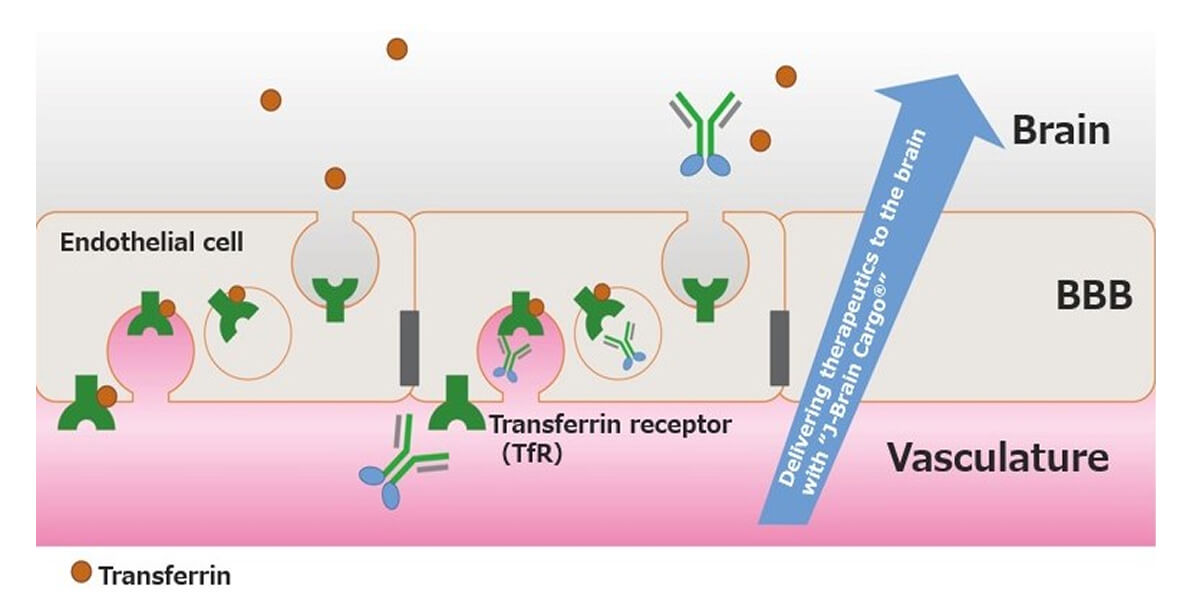
J-Brain Cargo® Works

Crossing the BBB was theoretically possible, but far from easy. I believe we were able to make it happen because JCR has a culture that respects and supports each researcher’s desire to take on challenges.
―Hiroyuki Sonoda

We create treatments
that go beyond rare disease
to solve the world’s most complex healthcare challenges.
JCR has turned difficult questions into new possibilities
by bringing research, development, manufacturing, and commercialization together as one integrated strength.
That strength has carried us through moments when the path forward was unclear and no model existed.
It has kept us moving when patients and families were still waiting for an answer.
What has never changed is the reason behind each challenge.
To stand with patients and families who are waiting for treatment.
To bring hope closer to the people who need it.
And to keep creating answers where they are needed most.
The journey continues.